How to Kill the RoboCop Inside Your Head
Southerners Against Surveillance Systems & Infrastructure
Prelude: How to Think Like a RoboCop
To the RoboCop, your life is a language written in 1s and 0s. Your body is a vehicle for behavior, an accidental husk devoid of genuine intelligence. Your every move is an input to an algorithm you will never understand. The RoboCop derives perfect knowledge of you by eliminating every aspect of your self unreadable to it. It reduces you to a sequence of directional arrows and judges you by your conformity to the future it predicts for you. All the things you hold most dearly about yourself are inconveniences to the police state. They are noise, interfering with the signal that affords absolute control. The RoboCop calls surveillance its lifeblood and data centers its body. Without these, the terror of your freedom might be within reach.
Introduction
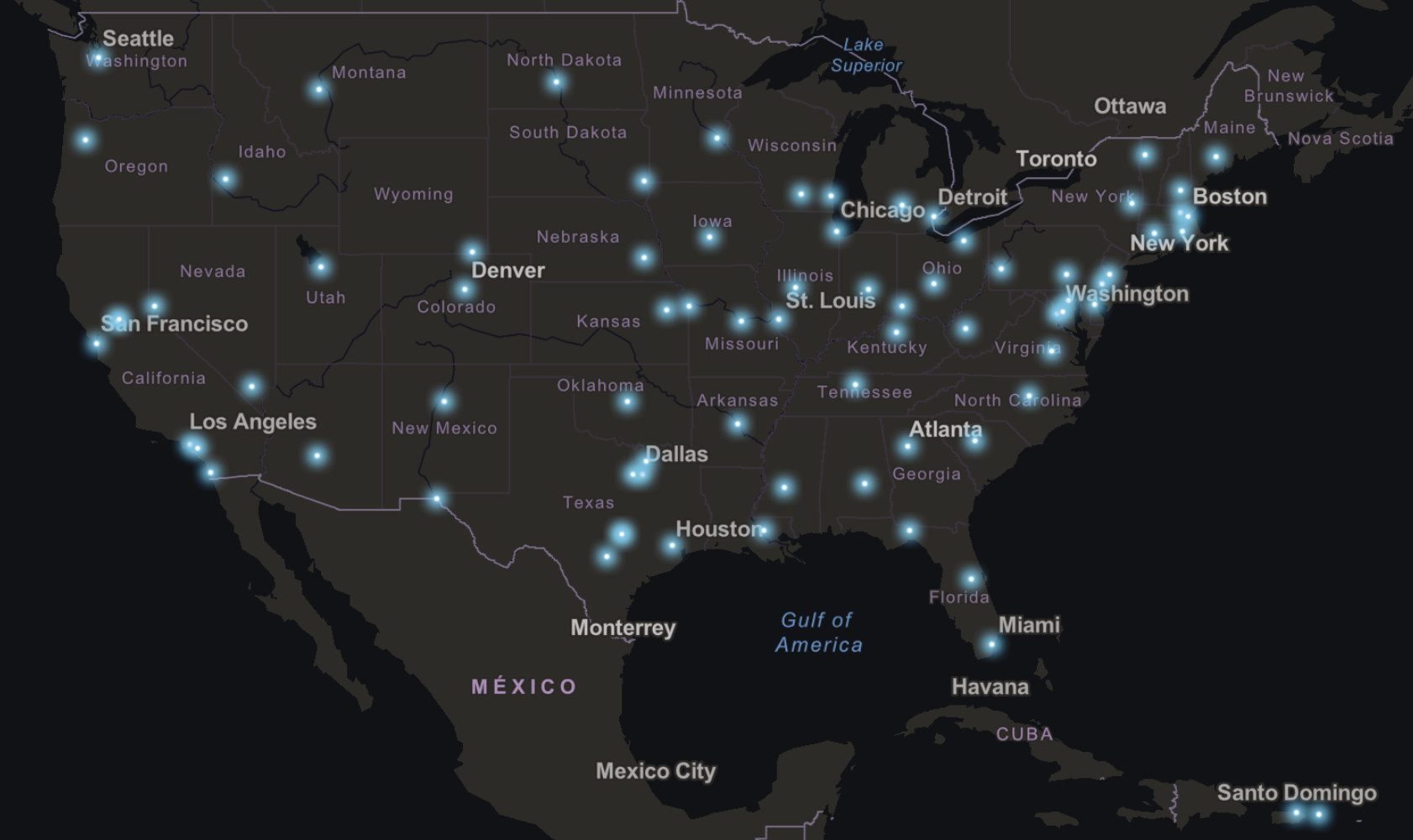
In the first quarter of 2026, roughly 75 data center projects totaling $130 billion were defeated or stalled. These fights have taken many forms, driven by environmental and political concerns. Data centers are resource-intensive industrial projects that produce audible and inaudible noise pollution, leach air and water pollutants, and convert neighborhoods into heat islands. They are also financial and political projects transferring land, natural resources, and state power to capitalists like Big Tech corporations. Importantly, the success of these companies depends on near-total surveillance. The money they invest in material infrastructure is justified by the flow of data from user to platform. And that very investment demands your life produce evermore data, to be sold to the highest bidder. This is called datafication, and it affords the state tremendous power. In the words of Roderic Crooks, "data is how the state sees its subjects and itself."
To make its subjects legible, the state must first datafy them. Once datafied, the state uses technologies to manufacture and extract data as if it were a natural resource. Among these technologies are the automated license plate readers that track your movements across state lines; the facial recognition algorithms that confirm your citizenship at the airport or your attendance at a protest; the predictive policing platforms that render your child criminal before they are born. But they are also the digital payment systems recording your every transaction; the social media monitoring tools flagging you as insurgent; the smart fridge that learns when your family sits down to dinner, that you are a vegetarian, and that your favorite ice cream is mint chocolate chip.
Datafication, surveillance, and control: this is the logic of the RoboCop. The fight against data centers is a fight to uproot this logic and plant new ways of being in its place.
Datafication Post-9/11
The current data center boondoggle is years in the making. The first quarter of this century has been marked by the rise of the data economy and the continued introduction of new digital consumer products designed to create, collect, and commodify data from daily life. Companies have appealed to progress and inevitability to peddle these transformations, much like data center developers are now doing. Of course, none of this was, or will remain, inevitable.
In response to 9/11, the federal government used the pretext of "national security" to deepen public-private partnerships between technology corporations and police. To encourage the rapid growth of the data economy, public funds were funneled into private industry to build an unprecedented surveillance architecture. This was justified by the intelligence community's consensus that 9/11 was the result of insufficient information sharing between law enforcement agencies across scales. At the heart of this transformation was the creation of the Department of Homeland Security (DHS) in 2003. This marked the largest reorganization of the federal government since the National Security Act of 1947. Since then, DHS has established its national security apparatus through two key infrastructures: the National Network of Fusion Centers and the Homeland Security Grant Program (HSGP).
Fusion centers, now numbering more than 80 across the country, are physical hubs where local, state, and federal police convene to exchange "intelligence." As such, their purpose is to collect, analyze, and disseminate data. In addition to the costs of building and maintaining these fusion centers, DHS grant programs have poured over $30 billion worth of funds into the creation and expansion of local real-time crime centers. These spy hubs are the lifeblood of the fusion center network. As a result, the surveillance-as-service industry has thrived, providing a parachute for Big Tech firms eager to satisfy the security state's appetite for data.
Following the 2000 dot com bubble burst, firms like Microsoft, Motorola, and Oracle pivoted to work closely with federal bureaucrats to grow the state's information sharing capabilities. Legislation like the Patriot Act framed indiscriminate data collection as necessary for combating future acts of "terrorism," guaranteeing a marketplace for warrantless surveillance. Yet the true cause of 9/11 was the United States' violent, decades-long intervention in the Middle East, which the failed war in Iran merely marks a continuation of. Seemingly overnight, government bureaucrats and corporate elites repurposed these military tactics and technologies domestically, reinventing the national security apparatus and padding their wallets at our expense.
Since then, local police departments and sheriff's offices have been flush with cash yearly despite narratives to the contrary, supported by a constant stream of grants and public funds. These flows of capital have fueled the rise of new and old surveillance-as-a-service companies like Flock Safety, Axon, Peregrine, Motorola Solutions, Genetec, and SoundThinking. While promoting public safety as a commodity to be bought and sold, they work with the state to build out infrastructures of political control.
As such, surveillance makes our communities less safe, rendering anyone and everyone visible to the RoboCop. It further concentrates resources in the coffers of police agencies and tech companies, leaving social services and public infrastructure to wither away. This is then justified with help from corporate media, which stokes moral panic about the conditions of precarity and unsafety produced by public disinvestment, deflecting blame onto those it portrays as "deviant" or "criminal." Through this process of threat fabrication, the state licenses itself to disproportionately surveil, police, and imprison communities cast as "threats" to national security. This includes, but will never be limited to, immigrants, people of color, queer folks, and political dissidents, be they communist, anarchist, or other. All the while, the RoboCop grows stronger.
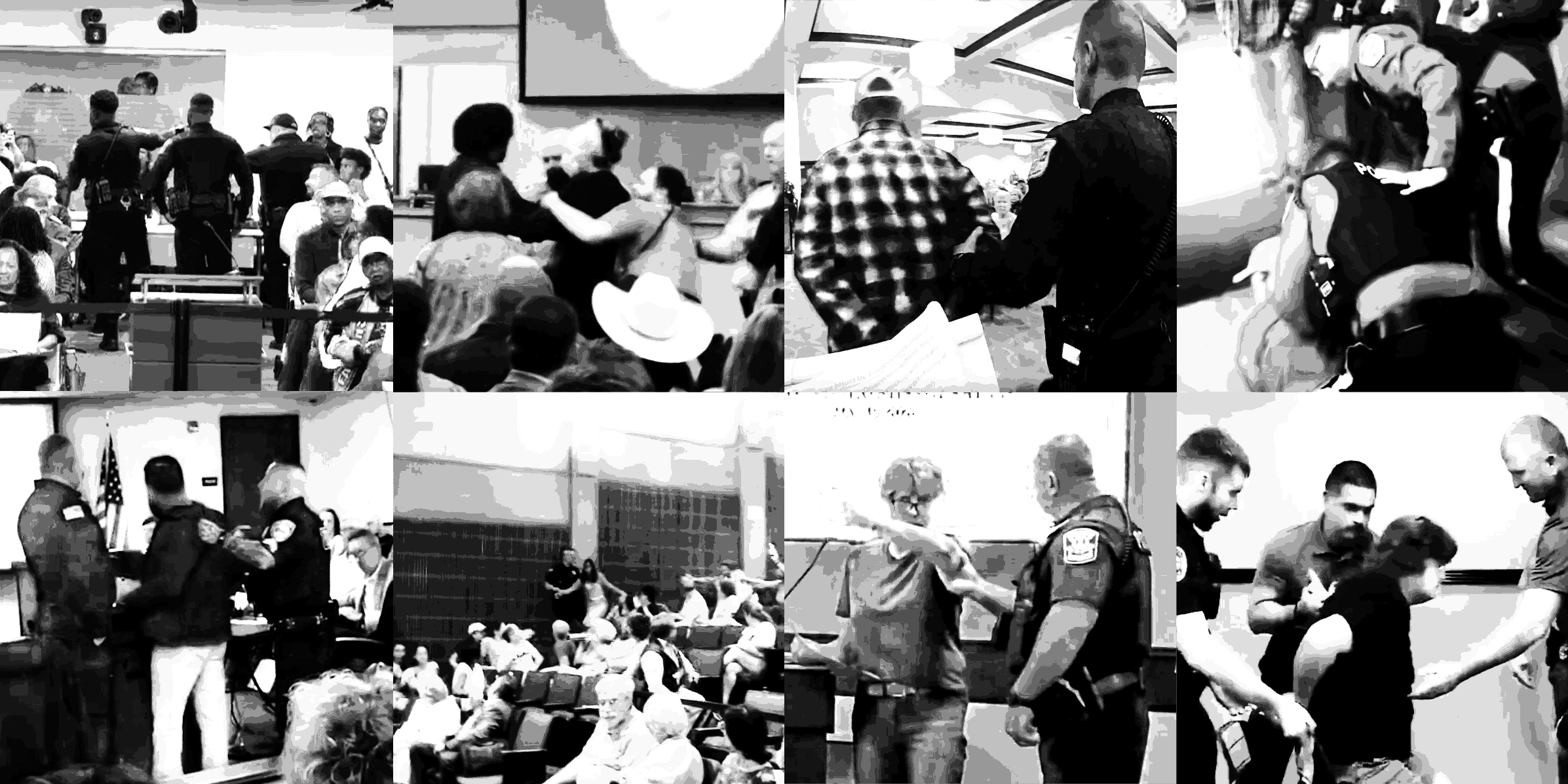
As this history makes clear, the drive for data center expansion is not just a push for profits and capture by Big Tech elites. It is also the logical extension of the "national security" apparatus that emerged following 9/11. Relying on an expansive web of surveillance technologies, real-time crime centers, and fusion centers, this monstrous organ of threat fabrication has worked night and day ever since to datafy, surveil, and control. The fight against data centers is therefore inseparable from the fight against surveillance. And, as the logic of the police state makes clear, these projects are outgrowths of a system of governance that prioritizes the accumulation of profit over the well-being of people. Such a system can only be sustained by violence, enforced by uniformed officers waiting to arrest you should your public comment go on too long or your demonstration grow too disruptive.
Surveilling for AI
Built on the production and processing of large volumes of user data, the data economy has normalized surveillance in the name of convenience and consumerism. The "artificial intelligence" systems created by Silicon Valley elites are merely its latest outgrowth. They could not exist without commodification and surveillance. Chatbots like those from OpenAI, Anthropic, and xAI were only made possible by farming the internet and the archives for everything ever written. Likewise, they are sustained by mining users' interactions for a continuous stream of training data. All the while, workers across virtually all sectors are being assigned to train their supposed replacements. This latest phase of the data economy feeds on your near-total visibility at home and at work: everything you read, watch, buy, like, listen to, love, fear, and hate is held hostage on a server rack somewhere, spewing heat into a burning atmosphere.
Self-driving cars and robotics—the Waymo cutting you off in traffic or the cop dog working security at your apartment complex—depend on a combination of gig work abroad and mass data manufactured at home to produce and sustain the appearance of "automated" intelligence. Like manufacturing and logistics, AI is built on the degradation of workers the world over, including the underpaying and traumatizing work of data labelers in Kenya, the Philippines, and elsewhere. Meanwhile, surveillance-as-a-service firms are increasingly incorporating AI systems into their product lines to usher in the next generation of predictive policing, where algorithms decide who is and isn't deserving of freedom before they are even born.
The logic of the RoboCop, and the AI that shields this logic behind a veil of progress and false objectivity, is that of prediction. Its aim is to eliminate all uncertainty, to account for every contingency by constraining what can and cannot be acted out. A constant stream of data circulates its fiber optic vessels like blood, fed by an ever-expanding network of surveillance. Increasingly, our lives are lived digitally, coerced onto platforms that monitor our behavior while anticipating our desires, projecting the past into the future through algorithms shielded from our scrutiny. And all of this—the construction of a data center down the street, the installation of a Flock camera across from the coffee shop, the removal of your friend or partner from public comment—is being accomplished against your will, without your say, because democracy in the United States has only ever been partial. Only now, more and more people are coming face-to-face with the reality of their exclusion.
Tech elites and the bureaucrats reorganizing the state on their behalf know that class war is not merely a "communist talking point" because they have been waging it against us for decades, and winning. Their fortunes are built on theft, legalized by the representatives they buy every election cycle while we struggle to make rent and afford groceries. Meanwhile, the bounds of our political and economic participation are narrowed without limit. Each bubble they manifest—be it the dot com crash, the Great Recession, or the current data center boom—is merely a means of transferring more wealth from our hands into theirs and with it, greater control over the structure of our lives. Behind the veil of capitalist "democracy"—the power of the wealthiest to dictate our future to us through coercion and force—sits the ever-present threat of state violence, wielded by an AI-charged domestic militia committed to defending the property of the elite no matter the costs to our communities and the planet.
The movements against data centers and surveillance are not movements against progress, but movements against the further consolidation of wealth and power in the hands of Big Tech billionaires who would rather bleed the planet dry than give us an inch. They are movements for genuine worker-led democracy and against the machinery of exploitation and profit that has been masquerading as democracy since 1776. The state's latest round of threat fabrication against immigrants, queer folks, and anti-capitalist ideology is the red flag of a bull fighter who knows that deception is the distance between life and death. Those of us organizing against data centers and surveillance are awakening to who our real targets ought to be.
Killing the RoboCop in Your Head
Data centers, fusion centers, and the systems of surveillance and control binding these infrastructures together can and will be dismantled. Every day, more and more communities are confronting their lack of agency and throwing sand in the RoboCop's gears. Yet, the state is wielding its power to force the machine onward, leaving waste and catastrophe in its tracks. Our strategies to date, while borne of necessity, are becoming insufficient to halt its forward progress. Beyond striving to dismantle it, we must construct new ways of being in its place. The question we must confront if we are going to win is: How can we live beyond the conditions of violence, domination, and control that are sold to us as convenience and security?
To start, we must construct models of community safety that do not treat people deemed "criminal" as erasable; that do not treat lands deemed "profitable" as expendable; that do not treat entire populations deemed "threats" as eliminable. Collective freedom may seem distant amidst the multiple crises we are facing, but we can begin to realize the world we want here and now by rejecting the RoboCop's logic of scarcity and meeting our neighbors where the state has abandoned them. It is daily practices of care, or mutual aid, that build towards direct democracy and abundance, ensuring that no one in our communities goes to bed hungry just to keep SpaceX stock in the green. That no one is driven into medical bankruptcy to pad the pockets of "health insurers." That no one is left without a roof over their head so private equity can add to their "housing stock." That no one is tortured in concentration camps to keep wages down.

The movements against data centers and surveillance are not movements against progress, but movements against the further consolidation of wealth and power in the hands of Big Tech billionaires who would rather bleed the planet dry than give us an inch.

Conversely, we must avoid doing the RoboCop's job for it, which is policing. Rather than relying on systems built to oppress and repress us, we must create alternative community infrastructures capable of addressing the conditions of abandonment and precarity that produce unsafety in the first place. Policing can only ever punish crime with more crime and violence with more violence, ensuring that we remain at arm's length from the bureaucrats and capitalist elites that rob us of the means to live well. We must recognize that policing is not a solution to social harm, but a perpetrator of it. That the state is directed towards political repression, or counterinsurgency, to defend the profits of those willing to commodify the air we breath and the water we drink.
In its place, we must develop models for responding to crisis and conflict that do not depend on robbing people who have done harm of their freedom. We must form neighborhood assemblies founded on direct democracy, where we vote on community matters without the mediation of bought-off bureaucracies. We must reimagine our relationship to the land and kinships that sustain us, rejecting false hierarchies and bringing democracy to all places of living, working, and learning. None of this work is easy, and it is in opposition to the punitive ways capitalism conditions us to think and relate to one another. It requires consistent study in community with others, interrogating how our ways of thinking reinforce the systems of division and domination that sustain the RoboCop and the capitalist state to the detriment of life on Earth.
To kill the RoboCop inside you head, you must reject the pipeline of datafication, surveillance, and control which hums, deafeningly, from data centers that could just as easily be prisons.
What is, so to speak, the object of abolition?
Not so much the abolition of prisons but the abolition of a society that could have prisons, that could have slavery, that could have the wage, and therefore not abolition as the elimination of anything but abolition as the founding of a new society.
— Fred Moten and Stefano Harney, The University and the Undercommons
Sources
-
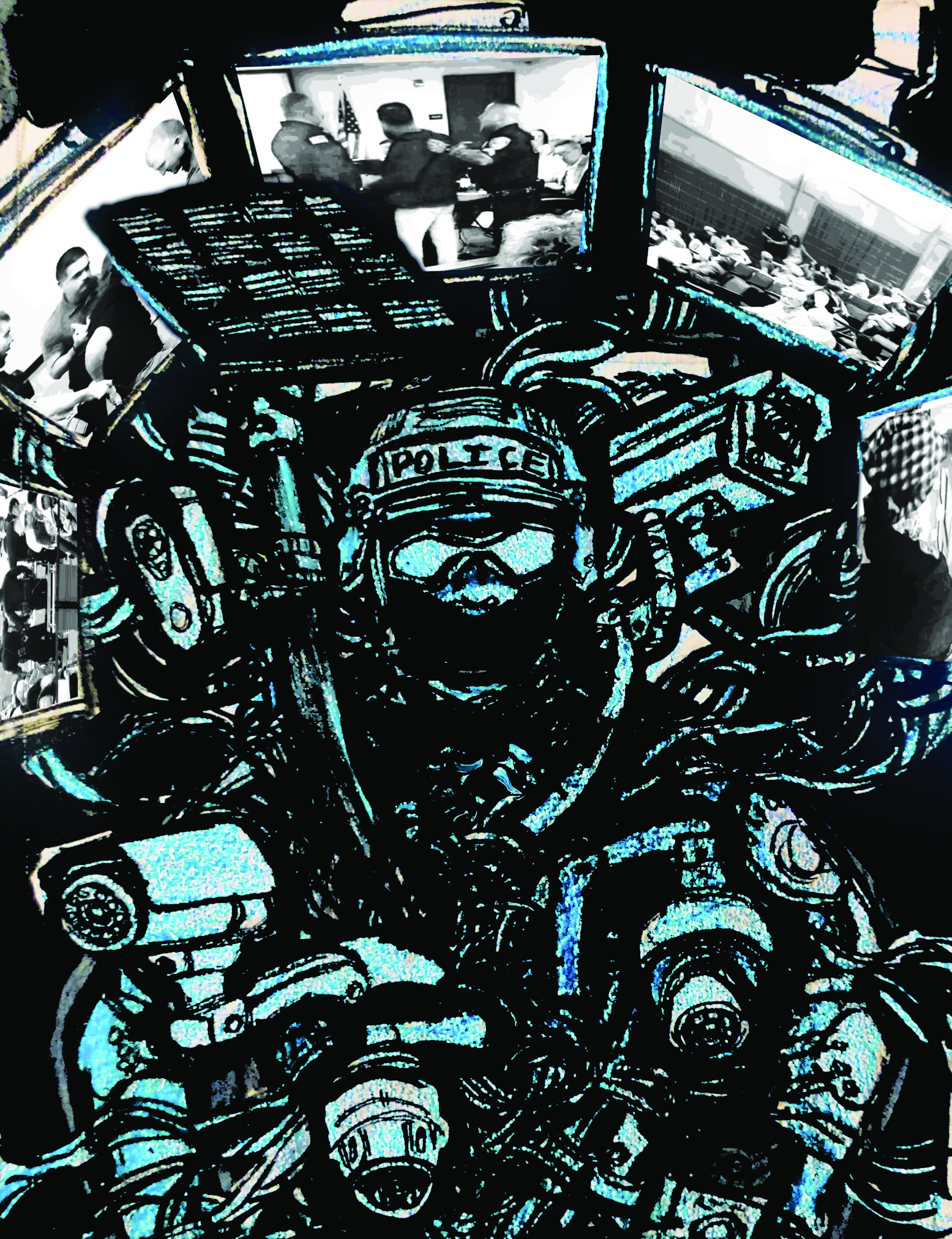
All images digitally modified and collaged by the editors.
(a) DeKalb County TV (DCTV). November 20, 2025. https://dekalbcountyga.granicus.com/player/clip/4835?view_id=2&redirect=true.
(b) Emily Schmalz (@etschmalz). July 28, 2026. https://www.instagram.com/p/DbWA1tYtTcS/.
(c) Claremore Police Department, obtained by 404 Media. February 17, 2026. https://404media.co/bodycam-footage-video-claremore-oklahoma-data-center-meeting/?action=signin&success=true.
(d) Ben Dziobek (@BenDziobek). May 8, 2026. https://x.com/BenDziobek/status/2052567297382875510/video/1.
(e) Fox 32 Chicago. May 8, 2026. https://fox32chicago.com/news/video-shows-man-removed-arrested-indiana-data-center-meeting.
(f) Wavelength Media. June 30, 2026. https://youtube.com/watch?v=7Ydo_Zvo1xA.
(g) Magnetic Norse (@MagneticNorse). May 20, 2026. https://x.com/MagneticNorse/status/2057189623143780410.
(h) Jason Bassler (@JasonBassler1). July 26, 2026. https://x.com/JasonBassler1/status/2081182966030745720.
↩ - National Fusion Center Association. n.d. https://nfcausa.org/fusion-centers/. ↩
- Illustration by Isaac (@lichensbugs) composited with images from 1(c), (e), (f), (h). ↩