Resources
Editors
Newsfeed
As the data center opposition continues building momentum, it attracts attention from all types of media outlets. Below are a few recommendations of writers worthy of your attention.
AI Bubble Monitor
The Center for Economic and Policy Research co-founder, economist Dean Baker, files weekly reports on the signals that an AI bubble is in the process of wreaking financial havoc.
"Chinese AI companies have produced a string of models that come ever closer, and in some areas surpass, the leading Silicon Valley models. They also maintain their enormous cost advantage, typically selling tokens for less than one-fifth the price—and often less than one-tenth the price.
If this is hard to grasp, imagine you're Elon Musk trying to sell Teslas for $50K a piece. Suppose there are Chinese models that are every bit as good selling for $5K. How do your business prospects look? That is the question US AI producers, as well as everyone in the supply chain, needs to be asking."
The Tech Bubble
Edward Ongweso Jr. is an independent writer, researcher, tech critic, and self-described evangelical Luddite writing on the political economy of tech development.
Blood in the Machine
Author and tech journalist Brian Merchant is AI Now's journalist-in-residence. His in-depth reporting covers AI, tech, labor and data centers. He permitted Reboot to excerpt his essay on the Luddite movement.
How to Survive the Broligarchy
Pulitzer-nominated investigative journalist Carole Cadwalladr pulls no punches in cataloging the actions of the super rich as they manipulate public policy and silence critics and journalists whose reporting they don't like.
Techno-Statecraft
Justin Kollar is a planner and socio-spatial researcher "map[ping] the collision of Big Tech, Finance, and the State to reveal the new geography of power" and "document[ing] the capture of public infrastructure by private interests."
Where's Your Ed At?
AI Bubble? What AI Bubble? Ed Zitron has relentlessly catalogued the tech oligarch grift long form for years. Detailed and scrupulous, Zitron is essential reading for understanding the political economy of the looming AI bubble burst.
Marcus on AI
Cognitive scientist, author, educator, and entrepreneur, Gary Marcus is a respected voice calling for restraint around AI's widespread deployment through regulation and increased "AI literacy."
The Hum: Stories from the Ground Beneath the Cloud
A Philly-based audio agency, Rowhome Productions, partnered with Saul Levin, program director for the Center for Nonviolent Conflict Research, to create The Hum podcast. According to its website, the podcast examines "who controls the future, featuring interviews with people fighting the march of AI and data centers into every aspect of our lives."
Allies
We are all in this together. No need to reinvent the wheel when so many groups are willing and able to help.
AI Data Center Map
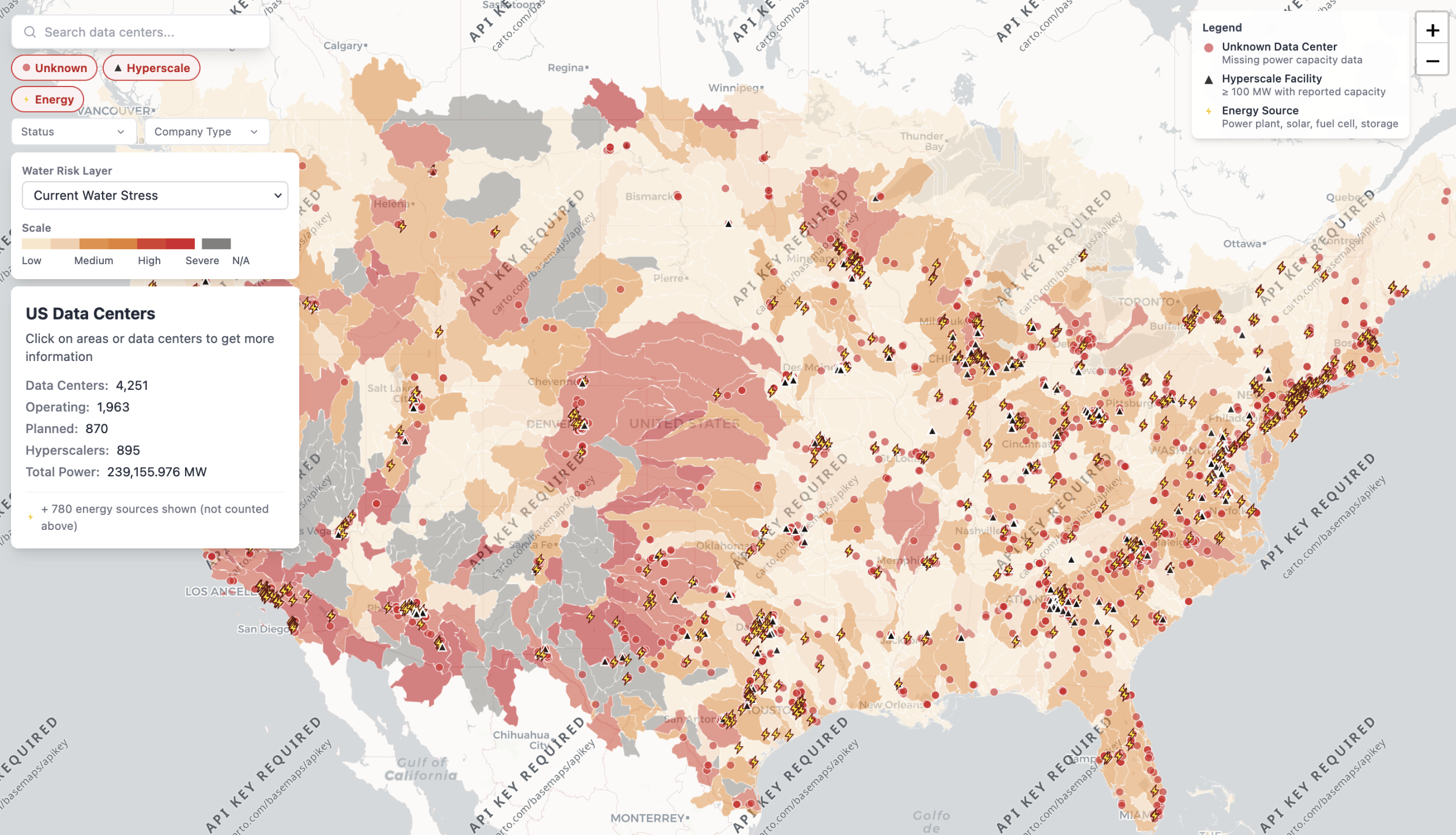
Find data center projects near you and estimate water and power risk and connect with other local activists. Help keep the map up-to-date by adding info on local projects. Also links to a downloadable AI Data Center Ecology Report on 4,500+ data centers in US and the many victories in stopping proposed projects.
Big Tech Unchecked
Detailed collection of effective strategies and tactics used in Wisconsin compiled by a coalition of health, environmental and public policy groups. Includes approaches to community organizing, building coalitions, and engaging in media outreach.
Climate Justice Alliance
Frontline activists who consider data centers "a recipe for community harm." Its vast network contributes resources and support to those combating data centers and artificial intelligence infrastructure with a special focus on Indigenous resistance.
Climate Revolution Action Network
New Jersey's only Gen-Z led Climate nonprofit has a strong message: Build Communities, Not Data Centers. Citing not only rising energy costs, financial speculation, and pollution, CRAN also calls out tech billionaires: Big Tech Does Not Care About Us. CRAN has worked with communities around the state to stop four data center projects and spurred passage of ordinances in five New Jersey municipalities.
Data Center Proposal Tracker
This citizen-run website uses public records to map locations around the country.
Data Center Policy Database
The DIGS (Digital Infrastructure Governance & Society) Lab at the University of Virginia has established a searchable database compiled after reviewing more than 700 federal, state, and local policies related to data centers.
Data Center Site Fight Guide
A consortium of nonprofits including Athena, Kairos, AI Now Institute, and Good Jobs First have established the Data Center Working Group and crafted a Shared Resource for Stopping Data Centers. The crowdsourced document is updated regularly. The main site also contains campaign resources: https://datacenterworkinggroup.org.
SASSI Surveillance Vendor Research Guide
Why should I care about computer-aided dispatch (CAD)? Are drone-mounted tasers a real thing? Southerners Against Surveillance Systems & Infrastructure produced this vendor research guide to help organizers map the surveillance apparatus where they live.
Food and Water Watch
Research by Food and Water Watch detailing the harms of AI data centers and the lies developers tell to try and manufacture community support.
Organizer Guide: The Costs of Data Centers to Our Communities and How to Fight Back
A collaboration between Kairos Fellowship and MediaJustice.
Public Citizen
Since 1971, this nonprofit consumer advocacy organization has championed the public interest in civic life. It has crafted pieces of model legislation suitable for reigning in unregulated AI including:
• Non-Consensual Intimate Deepfakes
• Election Deepfakes
• Consumers' Right to Know When Engaging with a Chatbot
• Use of AI in Healthcare Coverage Decisions
• Protecting Kids from Manipulative AI Chatbots
DeFlock
DeFlock is a crowd-sourced map of ALPRs and other surveillance technologies across the US built on OpenStreetMap. You can contribute by downloading the app and mapping nearby cameras here: https://deflock.org/app.
Uproar Movement
Are you in a local fight and need a way to start and host petitions? Send mass emails or texts? The Uproar Movement can help. We are providing free service to volunteer-led fights. To hear more, email: info@uproarmovement.org.
Resist and Unsubscribe & QuitGPT
Looking for ways to boycott Big Tech? Start here.
Electronic Frontier Foundation Street Level Surveillance
Since 1990, the Electronic Frontier Foundation has been a stalwart defender of civil liberties in the digital realm. Its Atlas of Surveillance, although not routinely updated, is a good starting point for learning common technologies deployed by law enforcement across the country. Their Surveillance Self-Defense guide describes how online surveillance works, recommends secure applications, and offers a series of security scenarios and roles people might find themselves in.
Reports
Some handy reports to help kickstart your research. But remember, your work is the backbone of this movement! We dictate the demands, not the non-profits!
Big Tech's PR Playbook for Overcoming Data Center Opponents

"[S]ome residents in affected communities reported feeling like insurgents against both Big Tech and local elected officials. At least some representatives of the tech industry agree: in September 2025, Kevin Nichols, an employee of the advocacy group Earth Charter Indiana, attended the Midwest Data Center Investment Conference and Expo (DICE) in Chicago, where he says he observed one speaker comparing his experience promoting data centers to counter-insurgency tactics the speaker used during military service in Iraq and Afghanistan, such as 'going undercover in bars and churches to gauge a community's potential for resistance to a data center development.'"
Environmental Cost of Artificial Intelligence: Carbon, Water, and Land Footprints
"The electricity-associated water footprint is about two tablespoons (29 mL) for a single AI image, but jumps to 4.1 liters for a complex video—almost equivalent to a two-day drinking water need for one person."
'Big Cloud' is Building Power via Pervasive Investments

"Startups receiving investment are especially at risk of heavy financial dependence on their Big Cloud partner as their sole or lead investor...That significant influence exerted by Big Cloud investors, in tandem with other anticompetitive strategies like high egress fees and minimum spend contracts, locks startups receiving investment into Big Cloud's ecosystems.
Cloud computing giants use these investments to exert influence over the entire tech industry, and especially over emerging (but yet unproven) technologies like AI."
The Dark Cloud: Data Centers as a New Frontier for the Climate Justice Movement
Since 2021, the UK-based Social Change Lab has studied which strategies and tactics work for social movements. This discussion paper lists strategies for climate activists to use in resisting data centers.
"AI capabilities and energy demands are evolving so fast that specific claims made today may date quickly. The durable argument is not about any particular energy figure or water consumption estimate. It is about a principle: that the public should have a meaningful say in decisions that reshape their communities, their energy systems, and their relationship to the natural world."
Digital Organizing Tools We Used to Produce Reboot
Signal
A user-friendly group messaging and video calling app with desktop and phone options. Reliable, open-source and end-to-end encrypted. Unlike other encrypted messaging apps like WhatsApp, there's no corporate/government backdoor—The Signal Foundation itself can't see the messages or who is in what groups. Several of us also use Signal for our local data center organizing.
Cryptpad/Cryptdrive
A free full-featured google docs/drive alternative. Open source and end-to-end encrypted. Occasionally a little glitchy, but did the job.
Riseup Pad
Neat utility for creating single collaborative notepads for meeting notes and group writing. Open-source and end-to-end encrypted.