Two Movement Stories
Editors
A Success in Tucson, Arizona
Residents of Tucson, Arizona have been organizing against a data center project for the last year, via the No Desert Data-Center Coalition (NDDC). Tucson sits in the heart of the Sonoran desert, a unique landscape home to the iconic Saguaro cactus and an incredible range of flowering plants and wildlife. Creatures here, including humans, manage to thrive in the presence of very little water—and less every year.
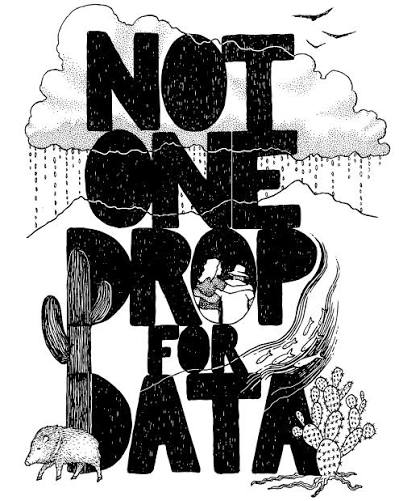
When the proposed data center "Project Blue" tried to annex into the city of Tucson, it faced a mass, grassroots resistance campaign. The developer had claimed annexation and city water were necessary for Project Blue's land sale, and the city's eventual rejection of annexation seemed like the end of the project. But the developer lied, and when annexation was denied, Project Blue just started to drill for water. The land sale went through, regional regulatory agencies were unresponsive, and the strategy of government advocacy was no longer working.
But the fight was not over. Neighbors living near the proposed site noticed water trucks arriving, branded with the logo of a local "eco-friendly" mulch business, Tank's Green Stuff. Researchers uncovered that the owner of Tank's, Jason Tankersley, also owned a shell LLC which operated a private well. Pre-development dust suppression and the drilling itself both require water; and that water was coming from a private well with the same owner as a local "sustainable" retail business. A pressure campaign took shape.
On a Friday, NDDC put out an Instagram post explaining this connection. That weekend, the coalition called for a "phone zap"—a mass call-in campaign—to demand Tankersley drop the water contract. The phone zap was also shared internally with committed movement members via Signal chats.
While this was going on, a group of community members outside of NDDC held an "office demo" at one Tank's location, where they chanted and delivered a satirical open letter. By early Monday morning, the company had released a public statement announcing that Tankersley had suspended the water supply to Project Blue.
This story from Tucson highlights the value of creative pressure campaigns. It also highlights the kinds of power that organizing builds. The thousands of Instagram followers and many committed movement participants who first came together through the government advocacy efforts against Project Blue then pivoted toward a targeted pressure campaign. Long-term organizing builds power, regardless of the actions of official "decision-makers."
Red Butte Anti-Nuclear Protests
On the weekend of May 16–17, 200–300 people gathered near Red Butte, or Wii’i Gdwiisa, the origin place of the Havasupai people, to protest the Pinyon Plain Mine and its hauling operations. Located seven miles from the South Rim of the Grand Canyon, this single site produces most of the uranium mined in the United States. During the gathering, protestors blocked a hauling truck on its way to the uranium mine. Their actions carried on a struggle now nearly a century old.
Residents of this region have experienced uranium mining as a slow-burning health nightmare for generations. Throughout the many years, residents and miners, many of them Navajo/Diné, have experienced high rates of cancer and organ failure due to the radon gas, uranium dust, and poisoned groundwater from the mines. In the 50s, the US government studied these dangers for a decade without alerting the community. Families built their houses out of radioactive materials, and children swam in open-pit mines filled with radioactive rainwater.
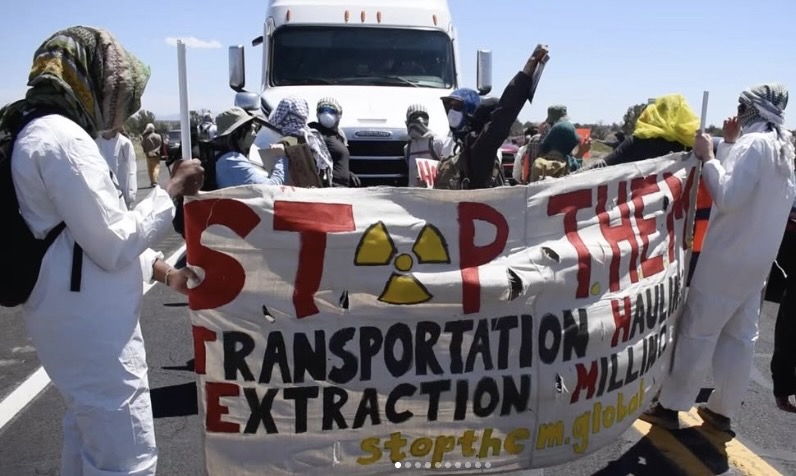
Some local residents still vividly recall the Church Rock spill of 1979 when a neglected dam broke, releasing 94 million gallons of radioactive liquid and 1100 tons of uranium waste into a river, which surged 80 miles downstream into family farms and livestock pastures. In 1986, the Navajo Nation shut down uranium mining on their territory. Off-reservation mining has since slowed, but not stopped completely.
The Pinyon Plain Mine was initially approved for operation in 1986. Its above-ground infrastructure was constructed in the the 1990s, but a 1992 crash in uranium prices caused the mine to be shut down before operations ever began. In 2012, the US Interior Secretary issued a 20-year moratorium on new mines near the Grand Canyon, but Pinyon Plain Mine was grandfathered in as an “existing right.” In December 2023, Energy Fuels, Inc. began extractive operations at the mine for the first time in history. While the inital contract for re-opening the mine was supposed to last 1–2 years, that has now been extended to 8–9 years. The struggle against Pinyon Plain Mine shows how Energy Fuels continues to persuade regulators to shift rules in their favor.
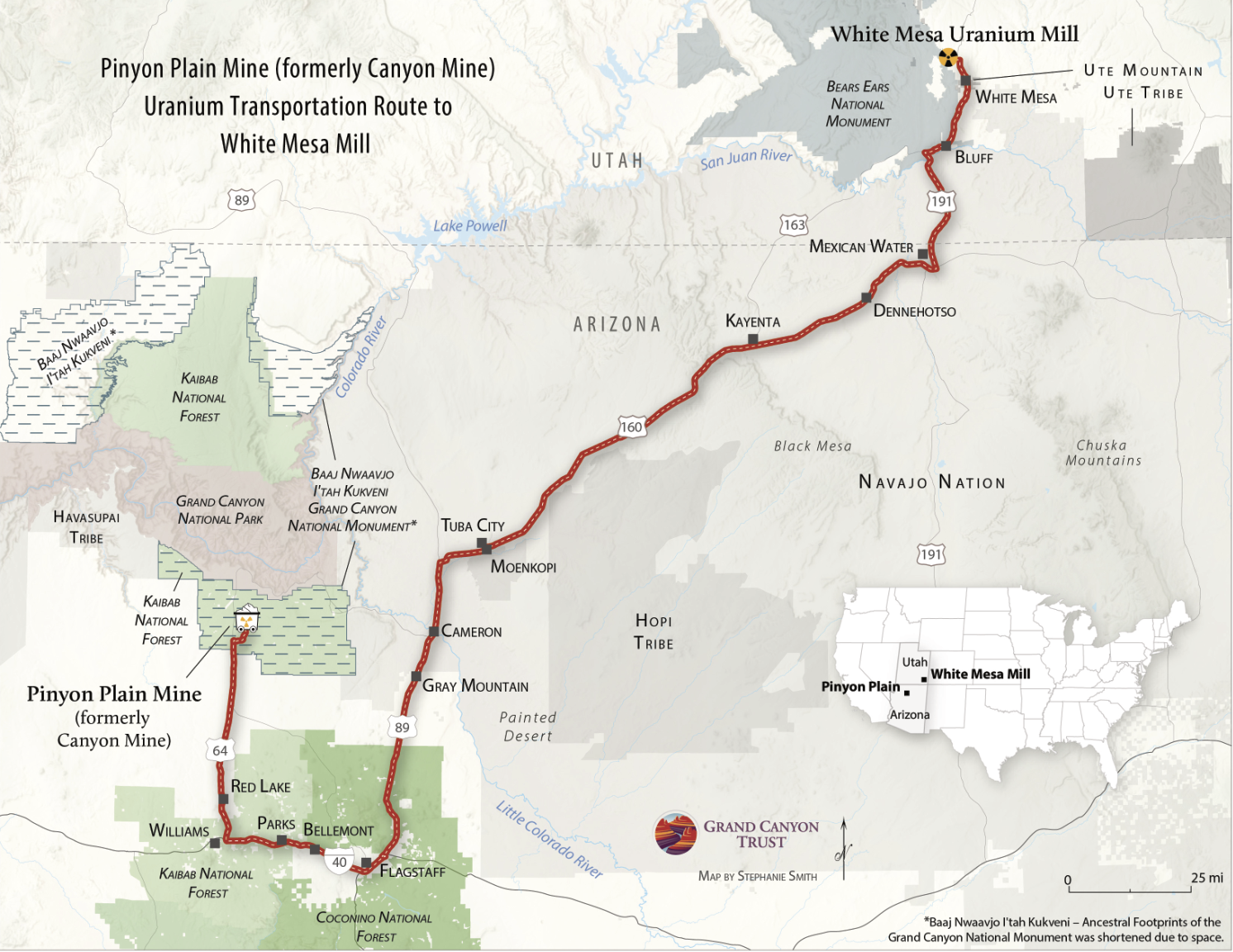
The 300-mile haul route from the Pinyon Plain Mine in the Kaibab National Forest to the White Mesa Uranium Mill poses a major threat to the surrounding ecosystems, waterways, and communities of people, plants, and animals. As many as 12 trucks per day travel directly through Navajo Nation and the Ute Mountain Reservation on the way to the Mill in White Mesa. Each of these trucks can carry up to 24 tons of raw ore, covered by nothing but a tarp. While Energy Fuels, the mine operator, is supposed to respect Navajo celebrations and ceremonies by pausing travel on these days, this agreement continues to be violated.
In recent years, the Biden and Trump administrations have both pushed to increase US nuclear production, and now data center mania has kicked the trend into overdrive. Proponents of new data centers claim their strain on our power grids can be addressed by reviving old nuclear plants and constructing facilities that are supposedly smaller and take less time to build. But the clever branding of "Small Modular Reactors" (SMRs) conceals data centers' massive power draw. Given the reality of data centers' power use, these would effectively be full-sized reactors, placed in rural communities across America. Even more troubling, SMR technology doesn’t actually exist yet and likely won't be available for at least another 20 years. The nuclear industry has promoted SMRs since the 1990’s, but the tech is still too expensive and slow to bring to market.
The danger of nuclear mining extends far beyond the Southwest. Nuclear waste is stored in 80 sites across 39 states. To this day, the only known way to “dispose” of nuclear waste is to bury contaminants underground for hundreds of thousands of years. Even if waste is buried, it is nearly impossible to guarantee the burial site will remain undisrupted for that long. Environmental laws are only put in place to mitigate risk, not to fully protect against disaster. Just two years ago, NBC News reported on a leak in Washington State, noting that historically, tens of millions of gallons of radioactive liquid have seeped from an old storage site into the surrounding soil and the Columbia river. This is just one of several leakage incidents at nuclear power and waste storage sites across rural America. Corporate PR might dismiss community health effects as the cost of progress, but with nuclear waste that cost is too high.
Supporters of nuclear power frame the technology as an inevitable necessity, but especially when used to power AI data centers, nuclear is clearly neither inevitable or necessary. Remembering the stories of the anti-nuclear movement can help us stand up to nuclear advocates who would rather forget, and stumble blindly into a disastrous future.