Understanding the Luddites in the Age of AI
Brian Merchant
“Luddite.” The word’s been circulating a lot lately, as investment in AI has reached historic heights, chatbots and enterprise AI have pervaded daily life, and more and more people have been speaking up about the drawbacks and dangers of the technology and the firms behind it.
“Luddite.” You may have heard the word used to describe AI critics, aggrieved workers, data center protestors, or those who advocate reining in AI companies, regulating their products, or putting checks on their power.
Its meaning, in these cases, is clear: It’s an insult. A Luddite is supposed to be anti-technology, naive, backwards, anti-progress.
And, surprise, the AI products enforce the idea. Here’s how ChatGPT defines it, when prompted: “A Luddite is a person who is opposed to, distrustful of, or reluctant to use new technology.”
Here’s Google: “A Luddite is a term for someone who is opposed to or resistant to new technologies, especially automation and computerization.”
Now, these AI-generated responses do reflect how the Luddites are commonly understood today. After all, large language models draw their responses from the inputs they’ve been trained on, and a lot of writing over the last two centuries has sought to define a ‘Luddite’ the way the chatbots do now.
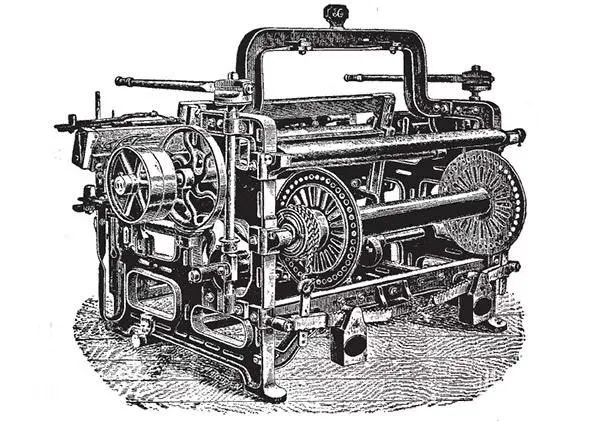
But the pundits and the chatbots all get it wrong: The real Luddites—the machine breakers who rose up at the dawn of the first Industrial Revolution to smash the looms and wide frames that factory owners were using to automate their labor—were not opposed to technology. They were opposed to the way technology was being used against them. That is, the Luddites objected to the industrialists who used machinery to depress wages, evade labor laws, and degrade the quality of products in order to profit at their expense.
It was, and remains, an eminently reasonable objection. The real Luddites were not know-nothing technophobes, despite their current reputation, and they certainly did not hate technology. In fact, many were technicians themselves, and understood better than most exactly how a technology would be used to exploit them. It was the rational and just thing to do, to object to the use of industrialist machinery to reshape their working lives and their communities.
Not only that, but their objections were informed, popular, and, for a time, effective. The Luddites organized a tactical rebellion that terrified elites and won the favor of the working class. People cheered them in the streets; hymns were sung about them in pubs. Lord Byron wrote poems about them. For a few years, they were more beloved than Robin Hood.
After all, we now sit on the precipice of a moment where backlash to a mass automation technology threatens to boil over again.
So who were the real Luddites? To understand them properly, we need a little background first.

The real Luddites—the machine breakers who rose up at the dawn of the first Industrial Revolution to smash the looms and wide frames that factory owners were using to automate their labor—were not opposed to technology. They were opposed to the way technology was being used against them.

In the 1700s and early 1800s, clothworkers constituted the largest industrial workforce in England apart from agriculture. Hundreds of thousands of people were employed, from Nottingham to Leeds to Manchester, as knitters, weavers, croppers, and spinners.
These clothworkers largely worked under what’s known as the domestic system; the artisans worked at home or in small shops, alongside their families or peers. Most were what we would describe today as working or middle class. They were not particularly wealthy or prosperous, and times could be lean if demand for cloth goods shifted, but many owned cottages, worked 30-hour workweeks, and had the autonomy to organize their workdays as they saw fit. They were free to sing songs at the loom as they worked with their families, or to take breaks to walk in the garden. Others labored in local shops with friends and colleagues they’d known all their lives. These were the days of the original “cottage industry,” and, in fact, it’s where the term hails from.
As the Industrial Revolution dawned, the early entrepreneurs began using automated machinery to speed up the labor process, and to organize production into the first factories. These machines, like the spinning jenny, the wide frame, the gig mill, and later the power loom, enabled factory owners to pursue mass production. The machines did not improve the quality of the product, and rather, often dramatically diminished it. But the more automated machinery could be overseen by untrained workers, so they reduced labor costs, even though this practice was often illegal: There were standards and laws that governed the cloth trade, that regulated things like thread count and product quality, as well as how long a worker had to serve as an apprentice before they could join the trade. Industrialists largely ignored these laws, in an early iteration of the ‘Move Fast and Break Things’ ethos popularized by Facebook in our time.
By employing a host of cheaper, untrained laborers, which often included children indentured from orphanages and poor families, and focusing on volume, not quality, the industrialist could drive down prices, corner markets and run skilled workers out of business.
As the 18th century wound down and the 19th began, the wages for clothworkers and artisans were plummeting. Early factory owners were concentrating wealth and power, enabling them to institute punishing working conditions and policies like paying workers in truck, or in goods produced by the factory, rather than money.
Clothworkers, their wages in free fall, organized a campaign to push Parliament to address their concerns: They asked for protections like a minimum wage, a ban on paying workers in truck, and for factory owners to simply follow the laws that were already on the books. Some also submitted novel proposals, like taxing the extra length of cloth produced by automated machinery, and using the proceeds to fund welfare and training programs for workers—proposals that look a lot like ‘robot taxes’ suggested today. Tens of thousands of clothworkers signed petitions calling for basic worker protections.
You may already have guessed what happened next: They were roundly ignored.
It’s important to underline this point. For nearly ten straight years, for much of the first decade of the 1800s, cloth workers tried to protest and petition peaceably, to do things “the right way”, even though their options for recourse were severely limited. Unionizing, or ‘combining’, was illegal in England at the time, so they couldn’t collectively bargain. There was no true democracy, no elected officials to hold accountable for allowing exploitation to continue unabated.
Eventually Parliament sided with the factory owners and threw out the remaining regulations governing the trade altogether. With thousands of workers impoverished to the point that they could not feed their families, and their backs against the wall, the Luddites rose up.
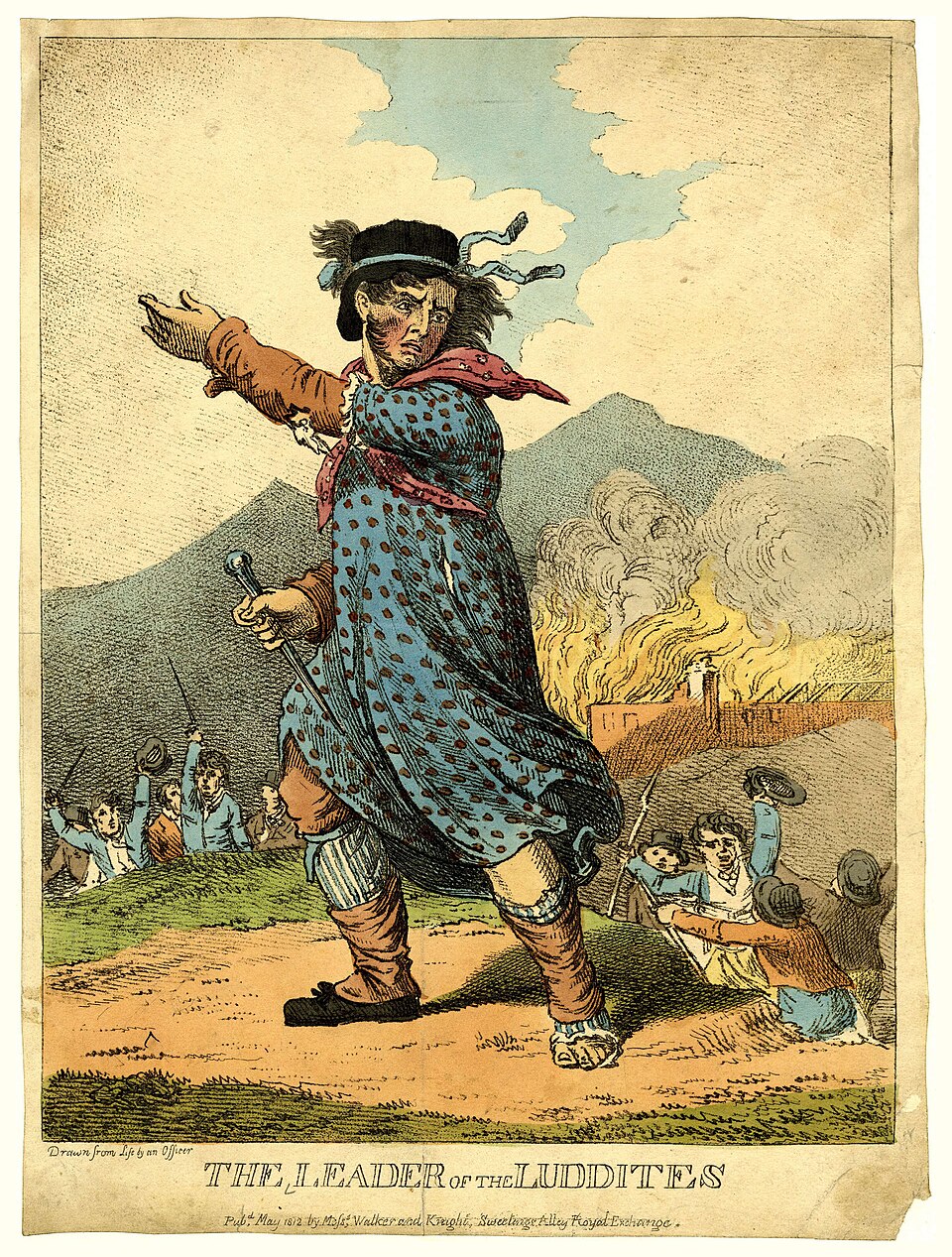
In Nottingham, in 1811, and drawing from a local tradition of dissent and, almost certainly, from the legend of Robin Hood, clothworkers who could bear no more launched a campaign targeting the worst offenders, those industrialists who paid the lowest wages and abused workers the most. They organized under the banner of Ned Ludd, an almost certainly fictitious avatar said to be an apprentice cloth worker. The legend went that Ned’s master had him whipped for being unproductive, so he smashed the master’s frames and fled into Sherwood forest.
The Luddites wrote letters to factory bosses warning them to take down the ‘obnoxious’ machines that had stolen the bread from their brothers’ mouths. If they didn’t, Ned Ludd’s army showed up: a handful, dozens or even hundreds of men, organized in military formation, answering by assigned numbers, not names. They would sneak in through the windows or hold up the overseer at gunpoint, and methodically smash just those machines that were deskilling their work; just the ones being used to tear up the social contract. They left the machines that were not being used to, say, automate their jobs or facilitate child labor, alone. But they would exit with a warning; bring them back, and we’ll return to do the whole place.
They were remarkably successful, for a time. After the initial outbreak of Luddism, factory bosses initially raised wages and negotiated deals with the workers, eager to protect their operations. They became heroes to many fellow workers, for fighting back against factorization and exploitation, for standing up to the powerful. When authorities demanded names of the Luddites per›petrating the machine-breaking, whole towns would stay silent; even when huge bounties were offered, no one came forward.
Ultimately, Luddism didn’t fizzle out because it was unpopular; it was crushed by the state. The Prince Regent’s government deployed thousands of troops to the industrial districts alight with Luddite activity. It was the biggest domestic occupation in British history. Parliament passed laws that made it a capital crime to break a machine, or to take secret oaths, essentially making being a Luddite a crime punishable by death. (Lord Byron made his first speech to the house of Lords in a thunderous defense of the Luddites, but was ignored by his peers, if not the public.)
As a result, scores of Luddites were hung by the state, and many others were killed in riots and raids as the factory owners grew emboldened to take up arms against them. Luddism died out by the end of the 1810s, but not before it helped to inspire Mary Shelley’s Frankenstein, a new generation of labor organizing, and paved the way for a raft of serious reforms like the overturning of the anti-union laws.
And yet, the Luddites today are still remembered as a punchline. As the cultural critic Theodore Rozak put it, “if the Luddites didn’t exist, their critics would have to invent them.” And to an extent, elites have done exactly this. By continually insisting that any criticism, objection, or resistance to commercial technologies are backwards looking, by linking objections to worker exploitation, antitrust violations, and surveillance to the Luddites, who dramatically lost their battle, they have turned a powerful working class movement with specific grievances about technological exploitation—and ideas about how to address it—into a caricature.
But the Luddites do not deserve derision; they deserve our empathy, even our admiration. They refused to “lay down and die” as the elites of the day might have hoped they would, and as the historian Frank Peel put it—and fought for workers’ rights despite everything.
What the Luddites fought for, after all, was ultimately pretty straightforward:
• Fair wages;
• Checks on fraud and abuse;
• A working life in which they maintained dignity and personal autonomy;
• A seat at the table in deciding how technology would be used in their workplaces and communities;
• To put down, not all machinery, but, as they put it in one of their most famous letters, “the machinery hurtful to commonality.”
The Luddites were not against progress or anti-technology. They were against exploitation; they were anti-poverty.
Only when wages were pushed so low that workers could not feed their families, when the indignity of soulless factory work looked inevitable, when fraud and exploitation ran rampant, and they had exhausted every avenue to have their voices heard did the Luddites take up their hammer.
Note on Publication
This is an excerpt from an article published in June 2026 on Substack with the same title. Brian Merchant is a technology journalist and the author of a book on Luddite history titled “Blood in the Machine: The Origins of the Rebellion Against Big Tech” (2023).