Welcome to Secret Server Club
Secret Server Club
Introduction
Data centers enact a world in which there are no neighbors, no belonging, and no interdependence. Our most intimate memories may live in the same server rack in Northern Virginia, but we have no way of sensing this proximity. This not only obfuscates our digital neighborly-ness to one another, but also prevents solidarity from developing in the first place. You can't organize with a neighbor you haven't met. The internet wasn't always like this and it doesn't have to be like this forever.
Knowing where our internet comes from feels as important as knowing where our food comes from. Using the word "cloud" to describe loud, hot, material, and resource-intensive masses of co-located computers is a metaphor that provides a peaceful abstraction for a violent system. This system offers temporary convenience in exchange for all of our data and our right to a voice in decision-making processes. Consumers enjoyed a decade of subsidized cab rides and streaming video, but the material effects of that supposedly frictionless system have become unavoidable, even for the most comfortably situated.
Internet access is now a checkpoint to accessing every part of civic life: citizenship, money, government services, education, healthcare, and sociality. On an internet underpinned by advertising, surveillance is a pervasive reality. Surveillance has become the cost of being a part of society.
As a collective, SSC strives to understand the internet history that led to the corporate cloud and the infiltration of surveillance into all dimensions of our lives. Simultaneously, we build the tools for navigating, resisting, and reimagining this environment together, as neighbors and friends.
Dreaming Up a Data Commons
SSC is a Secret Server Club, a Site of Shared Computing, a Small Shifting Cloud, a Super Sweet Commons.
SSC is a collective of artists, educators, and organizers experimenting with the stewardship of home-made digital storage. Situated in Los Angeles—where the internet was "born" in 1969, a hub for trans-Pacific submarine telecommunication lines, a city that pioneered predictive policing and automated license plate readers—SSC embeds itself in and as alternative infrastructure. We build community servers out of recycled parts in order to understand, make visible, and contest the architecture of the internet that exists where we live.
Over corn congee and many cups of tea, we began by envisioning a data commons: a place where data, art, and other digital artifacts could live together. A place where longevity is no longer determined by continuous individual purchases or subscription fees, but could be collectively maintained. A place where we acknowledge that the computer is manufactured through violent forms of extraction, where privacy is sacred, where data processing is a communal activity, and where we can practice divestment from corporate tech. A place where we steward one another's most precious files, together.
We asked: what happens when we hold our work in common? How can we reject the individuated device and choose shared social hardware? What would it look like to step away from the corporate cloud and create a shared data commons together? How might this exit feel less like exile and more like a homecoming? What resources can we pool together (financial, knowledge, space, capacity, etc) to develop and deploy our collective power?
What if, instead of each paying $150/year to cloud corporations, we collectively pooled these expenses into resilient community owned infrastructure? It was from this question that we formed a network called the Stone Soup Cluster. The name is in reference to a European folk story where villagers are persuaded to feed hungry travelers by each contributing a single ingredient to a pot of boiling water. While one potato (or a ten year old Chromebook) may not seem like much on its own, when everyone comes together with their remnants, they are able to collectively create and enjoy something that sustains the entire community.
We thought about how to use recycled hardware to deliver a comparable level of resiliency and reliability as a corporate system. We addressed this by leveraging networked redundancy, where copies of files and websites exist across many servers across the city, so no single machine becomes a point of failure.
SSC is more like a recipe than a formula. We contribute varied ingredients of capacity, technical skills, physical space and recycled hardware to feed a larger collective project. A recipe can be modified and adapted to suit local ingredients. On our cluster we host shared and personal websites, files, music, and we are working toward developing a community data cooperative, pooling resources to host resilient and redundant storage in Los Angeles (and beyond). We teach workshops in community spaces around LA, and we see the ways people in our community also yearn for a different relationship with technology. We collaborate on infrastructure projects with another computer club in the city, and every week attendance grows.
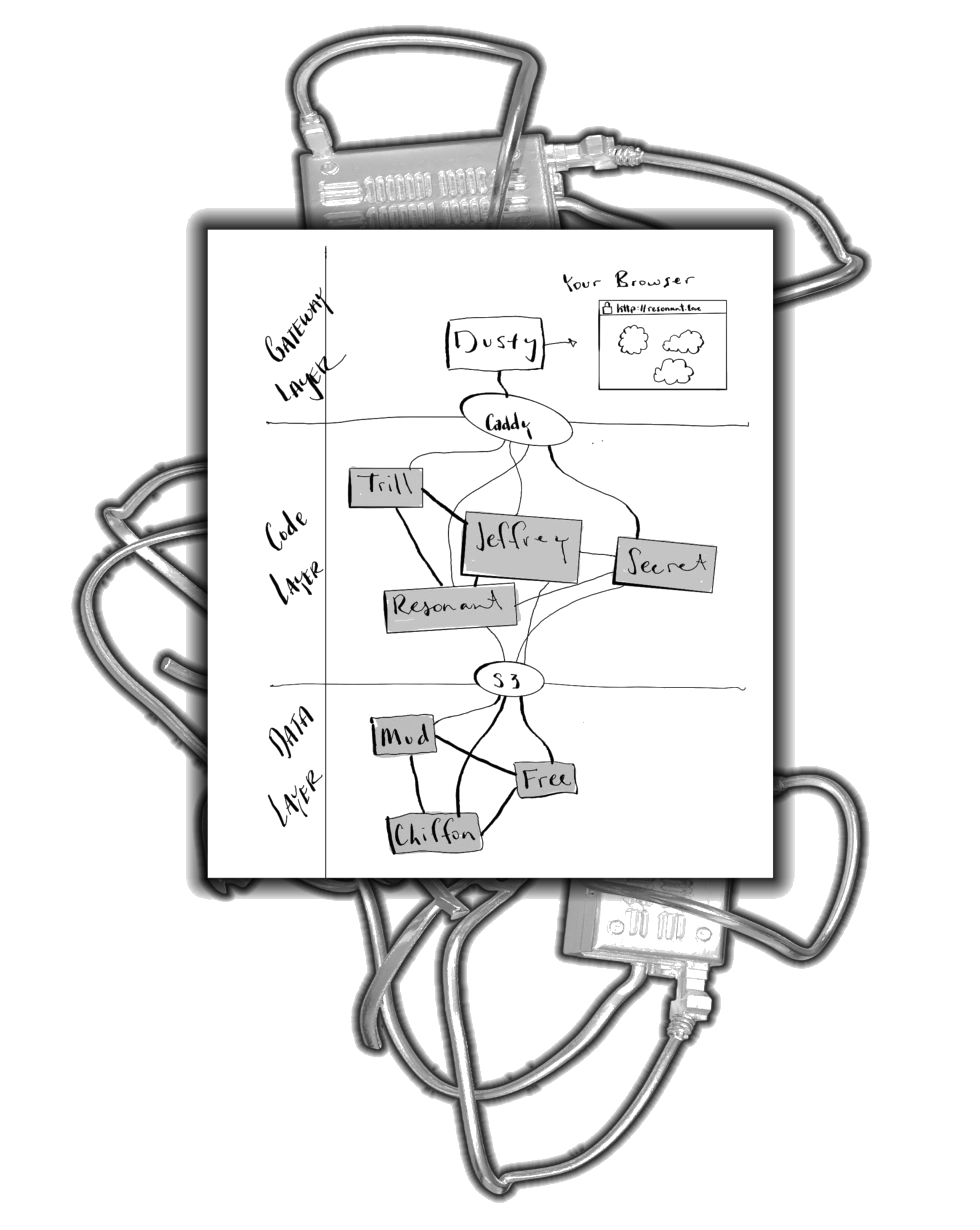
We operate around a three step recipe:
Make it easy: We ease the path into digital autonomy as a way of caring for one another, in opposition to the profit-driven approach. Self-hosting is daunting. Nobody has to have technical expertise to gain access to the services here. We take on the building and maintenance tasks together. For those who are curious about what's under the hood, we've written easy to follow documentation and create opportunities to talk about it together. The process of leaving the corporate cloud is difficult by design and we don't want you to have to do it alone.
Demystify: Abstraction is a natural part of technology development. It is not an inherent evil, but corporations weaponize it to maintain control over consumers. Squarespace has no interest in users understanding how a server works, because it would make their product irrelevant. Even as we develop useful abstractions to make hosting websites and storing files easier to understand, we take care not to lose sight of the tools and tactics beneath. We may use single sign-on to make joining our pirate media server easier, but if a term like "single sign-on" makes your eyes glaze over, we're here if you'd like to learn what that means or how that works.
Mysticize: As we begin to ground in our new rituals of computational commoning, we hold with reverence the knowledge that our computers came from the ground, and were held by many hands before they reached us. We can re-mysticize our experience by asking ourselves about the new worlds that could come into being when our collective practices form a strong enough fabric to bear the weight of them. Each new server provision begins with a prayer, acknowledging the long journey the machine took to reach us.
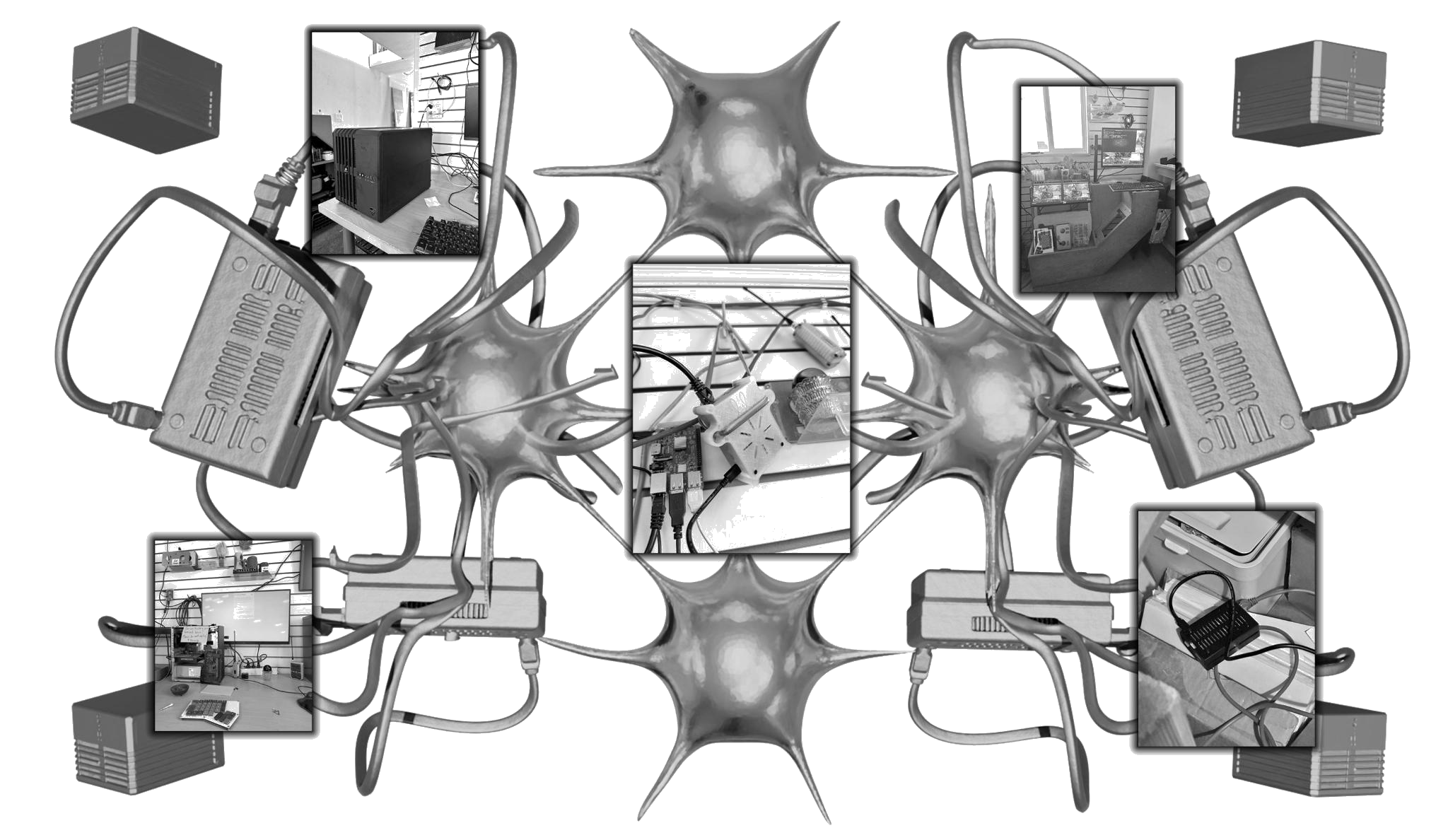
So what do you actually do on a server? You can replace many corporate platforms! Instead of Netflix and Spotify you can run a collectively maintained Jellyfin server that allows media streaming for music, TV, movies, and even retro video games. You can replace iCloud photos with tools like Immich and Nextcloud.
But this is more than just "Netflix and Google Drive, but we run it." Something special happens when you collectivize taste. Instead of 50 million songs fed to you by an algorithm, our server has a collection of 50,000—every single one of which was picked and added to our collection by our friends. We've gone on 8 hour road trips listening to music from our Jellyfin server the whole way!
In 2025, Windows stopped support for any Intel processor built before 2017. A PC purchased brand new in 2020 has already been abandoned by its creators. Just because these machines don't run Windows anymore doesn't mean they are useless. Quite the opposite: these machines run Linux better than they ever ran Windows, and their abandonment means that hardware is actually cheaper than ever.
Linux is an operating system like MacOS or Windows that's free and open source with hundreds of different variants or 'flavors.' None of them advertise or surveil. You don't need to give them your email to log in. Some popular variants are Ubuntu, Debian, and Fedora, with specialized versions like Open Media Vault for managing media servers.
What kinds of machines do we use to do this? Dell Optiplexes discarded from offices are a dime a dozen. Desktop PCs with pre-7th generation Intel processors are similarly affordable. These can cost anywhere from $20 to $150.
Keywords for Craigslist or Marketplace:
• Intel 4th gen, 5th gen, 6th gen
• Optiplex
• Thinkstation
The data center bubble has also doubled or tripled the price of new hard drives. While data hoarders on Reddit will tell you that a hard drive's life span is 4–6 years, in practice they can live much longer, and unstable hardware is less of a problem when data is replicated across a cluster of drives.
One useful tactic for getting affordable storage is "shucking" old external hard drives, taking them out of their housing to put into a used computer. These drives often have low use-hours and write time, because they were used for periodic backups rather than daily activities. The USB interface built into these devices tends to fail before the actual drive does, which means that they can be purchased for much less than market value. We target $10–20 per terabyte.
None of us knew how to do any of this two years ago. And at first, these tasks seemed scary. But together, we make each other brave.
Re-Engaging With What We've Lost: Maintenance and Friction
Convenience may once have granted time back to us, but following the logic of Jevon's paradox, that time has become a site of ever-increasing extraction. Convenience has become a means for alienating us from one another, and obscuring the total reality of physical infrastructures & their afterlives. Jeff Bezos launched Amazon Web Services in order to rescue us (or rather, developers) from the maintenance labor he sees as unglamorous. Now we have a technology that happens to us, which we have little agency to question, critique, or change. Much of our present landscape of convenience can be understood as the offloading of maintenance work and reduction of friction in exchange for centralized control.
By converting the debris of "progress" into a locally-hosted community server, we're turning e-waste into a trellis on which the vines of our collective practices can grow, a site where commoning can happen. So far, we're learning that the technology of sharing is enacted through the poetics of maintenance, and the intimate nature of working together through friction. Let us not forget that a world without friction is a world without touch. Sharing a computer brings those sharing it into certain forms of intimate contact. This intimacy, like any intimacy, requires negotiation (friction) and ongoing attention (maintenance). Immediately, we find ourselves presented with a series of questions, such as:
• How do we make decisions together in ways that don't recreate transactional and dispensable relationships?
• How do we balance burdens, both among our shared computers and among each other?
• How do we support each other through "convenience withdrawals"?
• How do we resolve conflict when it arises?
These questions, and the processes that help us address them, are important because they ask us to exit the individualist mode of being online in favor of another more interdependent way. But we must remember that the processes of engaging with these questions involves closeness and contact, and thus: friction. By choosing friction we choose conviviality.
Conclusion
As SSC, our goal is to enact a way of being with technology that is less individualistic, less panoptic, less exploitative, and in turn more multiplayer, more neighborly, more collaborative. The joyful frictions where learning, community, and agency are most palpable have been stolen and rented back to us in the form of precarious subscription platforms in the cloud. We merrily reclaim them: as Stone Soup Clusters, as rituals for reviving scrapped silicon, as conversation over congee and tea.
The latest moment of AI hyperscalers is an extension of an already entrenched data center industry which has centralized computing in the extractive systems of Google, Amazon, and mainstream social media platforms. The thirsty e-waste factories are already here. The last two decades have only accelerated our alienation from the means of computation. Youth who have grown up with computers all of their lives rarely know how they work, let alone how to fix them, or how to do anything other than pay the rising prices of shrinking cloud storage.
We created Secret Server Club in response to the these crushing realities—as an experiment in refusal and commoning; an opportunity for people to learn together, experiment, build infrastructure away from corporate technology. We've basked in the warmth of this friction, tasted the richness of these congelations. We hope you will too. Pair with scallions, serve in as many small vessels as you can muster.
May this recipe offer a source of inspiration and possibility for building futures outside of the corporate cloud. It's easier than ever to make a server from the computer under your bed, and it's even easier when you do it with and for a friend.
A SSC deployment prayer:
May your drives spin ever smoothly, and be rematriated with grace one day to the earth.
As may we
( _     _ )
 ~////||\\\\~